Introduction: The Miracle in Your Pocket
How can a device as thin as a slice of bread capture vibrant sunset landscapes, crisp night shots, and DSLR-style portraits with softly blurred backgrounds?
Physics tells us that great photography requires large lenses to gather light and massive image sensors to capture fine detail. Yet, the tiny camera modules jammed into modern smartphones defy these traditional optics laws. The secret doesn’t lie in glass or mirror boxes; it lies in algorithms.
Welcome to the era of computational photography in smartphones. Through digital math, hardware integration, and software engineering, mobile devices process image data in ways physical cameras never could.Software has replaced heavy glass elements, turning mobile devices into some of the most capable imaging platforms ever created.
What is Computational Photography?
At its core, computational photography refers to digital image capture and processing techniques that use algorithms rather than optical physics alone to create or enhance a photograph.
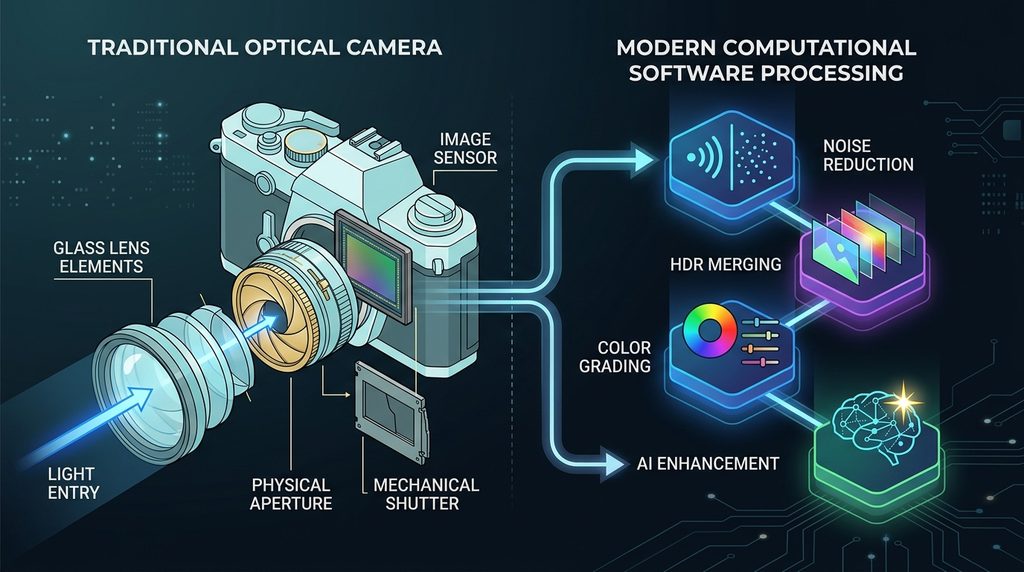
In a traditional camera, light passes through a glass lens, hits a sensor, and saves directly as an image file with minimal digital intervention. In contrast, smartphone camera software treats the light coming through the lens as raw raw data—an initial building block rather than the final picture.
Key Takeaway: Traditional photography relies on hardware optics (gathering physical light through glass). Computational photography relies on software computation (calculating, combining, and enhancing image data digitally).
Instead of taking a single picture when you tap the shutter button, a smartphone running modern computational photography algorithms captures a rapid burst of multiple images, analyzes every pixel in real-time, and merges the best parts of each frame into a single exposure.
How Computational Photography Works Inside a Smartphone
The journey from pressing “shoot” to viewing a finished picture takes less than a second, but it involves millions of mathematical calculations across specialized processing hardware.
[ Light Input ] ➔ [ Image Sensor ] ➔ [ Burst Capture Buffer ] ➔ [ ISP & NPU Alignment ] ➔ [ Final Composite Image ]
Step 1: The Sensor Capture Phase
When you open your camera app, your smartphone sensor is already constantly capturing frames into a temporary memory buffer. By the time your finger taps the shutter button, the camera has already recorded several frames before, during, and after the click.
Step 2: Multi-Frame Burst Processing
Instead of relying on one exposure, smartphone image processing uses multi-frame fusion.The camera records a sequence of shots taken at varying exposure levels—some dark to capture highlight details, some bright to extract shadow detail, and some in-between for accurate color.
Step 3: ISP and NPU Hardware Pipeline
The raw frame data routes into two crucial silicon chips inside your phone’s processor:
- Image Signal Processor (ISP): Handles low-level raw image tasks like color correction, demosaicing (converting raw sensor data into red, green, and blue pixels), white balance adjustments, and noise reduction.
- Neural Processing Unit (NPU): Dedicated silicon designed for AI photography tasks. It uses deep learning algorithms to detect subjects, segment backgrounds, reconstruct missing details, and optimize local exposure.
The system aligns every frame to fix micro-hand-shakes, discards blurry pixels, and stitches the best visual elements into one balanced image file.
The Role of AI and Machine Learning in Smartphone Cameras
Artificial intelligence is no longer an optional camera extra; AI photography forms the core backbone of smartphone camera technology.Modern camera apps use trained machine learning models to analyze scene geometry before you even press the shutter.
Raw Sensor Input ➔ Machine Learning Scene Model ➔ Object Segmentation ➔ Targeted Exposure / Color Polish
Semantic Segmentation and Scene Recognition
Older camera hardware applied edits uniformly across an entire image. Modern AI camera software uses semantic segmentation—breaking down an image into individual object categories like sky, skin, fabric, foliage, or architecture.
| Image Layer | AI Semantic Action |
| Human Subject | Preserves natural skin tone, brightens eyes, reduces shadow noise. |
| Sky / Clouds | Lowers highlights, enhances blue tone gradients, sharpens cloud edge detail. |
| Foliage / Plants | Sharpens leaf edges without adding harsh digital artifacts. |
| Background | Adjusts global contrast while isolating subject lighting. |
Generative Detail and AI Zoom
When zooming past a phone’s physical focal length, standard digital zoom stretches existing pixels, making photos look blurry and pixelated. Computational AI camera zoom uses neural networks trained on millions of high-resolution images to predict and reconstruct fine details—like fabric weaves, tree bark, or distant signs—turning digital crop zoom into clear images.
Key Features Powered by Computational Photography
Every modern flagship feature rely on software multi-frame merging.
Dynamic Range Mastery: HDR Photography
Traditional single-shot camera captures struggle when a scene features both bright sunlight and dark shadow pockets. HDR photography (High Dynamic Range) solves this issue by shooting rapid exposure variations:
- Underexposed framescapture highlights (e.g., bright sky, direct sun flare) without blowout.
- Overexposed framespull clear shadow detail out of dark regions.
- Mid-exposure frames maintain natural mid-tone color reproduction.
Computational software merges these frames pixel-by-pixel, delivering photos with evenly lit details from edge to edge.
Defying the Dark: Night Mode
Physical camera sensors require large surface areas or long exposures to gather ambient light at night. Night mode brings that functionality to tiny mobile camera sensors through computational alignment:
- The phone captures 10 to 30 low-exposure frames over 1–5 seconds.
- Algorithms calculate hand tremor movement between frames and realign the stack.
- Random low-light grain and digital noise are mathematically isolated and purged.
- Dark frames merge to accumulate ambient light without blowing out highlights or adding motion blur.
Digital Depth: Portrait Mode and Bokeh
DSLR and mirrorless lenses produce smooth background blur (bokeh) using wide optical apertures. Smartphone camera lenses are too tiny to create shallow depth-of-field naturally.
Portrait mode mimics this optical effect mathematically:
- Dual-lens systems or stereo-vision software generate a precise 3D depth map measuring distances between objects and the lens.
- AI algorithms segment foreground subjects (including tricky stray hair strands) away from background objects.
- A realistic Gaussian or optical blur mask applies strictly to background depth layers, recreating true optical bokeh.
Computational Cleanliness: Noise Reduction and Sharpening
Tiny smartphone image sensors generate high digital noise in low light. Rather than smoothing photos into blurry shapes, smartphone image processing cross-references successive video frames.Static pixels retain sharpness, while random grain patterns across frames are identified and scrubbed away automatically.
Traditional Photography vs. Computational Photography
While both approaches capture visual memories, their underlying philosophies differ entirely:
| Feature / Trait | Traditional Photography | Computational Photography |
| Primary Driver | Physical optics, glass elements, large sensor size | Code algorithms, multi-frame bursts, processing power |
| Capture Style | Single instantaneous physical shutter exposure | Multi-frame dynamic exposure fusion |
| Form Factor | Bulky camera bodies and interchangeable lenses | Ultra-slim pocket devices |
| Post-Processing | Manual editing required in RAW processing apps | Instant automated processing in milliseconds |
| Low-Light Capture | Requires physical tripods or high ISO sensitivity settings | Multi-frame handheld stabilization algorithms |
| Depth Blur | Pure physical lens optics and aperture geometry | AI-generated spatial depth mapping and blur masks |
Why Computational Photography Matters for Smartphones
Physics imposes strict size boundaries on hardware innovation. A smartphone cannot fit a 50mm f/1.2 glass lens or a full-frame sensor inside a body under 8mm thick without creating an unusable camera bump.
Hardware Limits (Tiny Lenses & Small Sensors)
                     +
Computational Software (Burst Fusion + AI Neural Engines)
                     =
DSLR-Class Dynamic Range & Clarity in Your Pocket
Software breaks through hardware constraints.By swapping heavy glass for raw computational horsepower, smartphone photography technology delivers image quality that challenges dedicated professional gear in everyday shooting environments.
Daily Examples: Computational Photography in Action
You use computational photography algorithms constantly without realizing it:
- Group Photos Where Everyone Is Smiling: Camera software picks open eyes and smiles across sequential burst shots, merging them into one optimal group frame.
- Sunset Horizon Shots:Shooting directly toward bright light captures both golden sky gradients and shadow foreground details simultaneously.
- Concert Videos and Photos:Bright stage spotlights don’t wash out performer faces, while dark crowds remain visible and detailed.
- Action Zoom Shots:Watching sports from stadium seats and zooming in 10x yields sharp, readable jersey text via generative detail reconstruction.
Advantages and Limitations of Computational Photography
Advantages
- Pro Quality without Bulk: Capture high-grade images without carrying heavy lenses or camera gear.
- Zero-Effort Perfection: Instant lighting balance, auto-focus, and colors mean anyone can shoot clear photos right away.
- Low-Light Magic:Handheld low-light capture outperforms single exposure settings on traditional camera sensors.
- Continuous Updates:Your smartphone camera system improves over time via software over-the-air updates.
Limitations
- Over-Processed Aesthetics:High contrast, overly sharpened edges, or plastic-looking skin can make photos feel artificial.
- Edge Artifacts:Portrait mode depth maps can miscalculate fine object borders like thin glass stems, dog fur, or loose hair strands.
- Thermal and Battery Strain:Multi-frame AI processing places high power demands on mobile processors during long photo shoots.
- Motion Artifacts (“Ghosting”):Fast-moving subjects across multi-frame HDR captures can leave faint trailing outlines if alignment algorithms struggle.
The Future of Computational Photography in Smartphones
As mobile chips feature more powerful dedicated NPUs, computational photography in smartphones is moving into real-time computational video processing and interactive generative editing.
Multi-Frame Still Processing ➔ Real-time Computational Video ➔ Generative AI & Interactive Spatial Scene Edits
- Real-Time 4K Computational Video:Extending complex multi-frame HDR and Night Mode algorithms across 60 video frames per second.
- Generative Relighting and Angle Adjustment:AI tools that let users move lighting sources or slightly adjust camera angles after capturing a shot.
- Generative Element Removal and Fill:Cleanly removing background distractions and reconstructing underlying textures on-device instantly.
- Authenticity Certification:Standardized cryptographic watermarking to help distinguish unaltered computational real photos from heavily modified generative AI imagery.
Conclusion: Software is the New Lens
The leap in mobile photography quality over the last decade wasn’t driven by bigger optical lenses; it was forged through code.Computational photography in smartphones bridges the gap between hardware physics and user expectations.
By using machine learning, multi-frame exposure processing, and neural network depth mapping, smartphones turn tiny optical components into high-grade image engines.As processors become faster and algorithms smarter, software will continue pushing the boundaries of what mobile devices can capture.
Frequently Asked Questions (FAQ)
What is computational photography in smartphones?
Computational photography in smartphones refers to software algorithms, machine learning, and hardware processing that enhance, adjust, and merge raw photo data to produce higher-quality photos than small camera optics could capture on their own.
Does computational photography replace traditional camera lenses?
It doesn’t replace physical glass entirely, but it offsets hardware physical limits.Small camera lenses still gather physical light, but computational algorithms enhance color, lighting, detail, and focus digitally.
How does Night Mode work without a tripod?
Night mode captures multiple short exposures over a few seconds.Algorithms realign these frames to correct hand shaking, purge digital noise, and merge light data into a bright, clear photo.
Why do smartphone photos sometimes look artificial or over-processed?
Over-processing happens when algorithms apply aggressive edge sharpening, high local contrast, or strong noise reduction.Tuning these software settings balances natural tone against crisp clarity.
What is the difference between an ISP and an NPU in mobile photography?
The Image Signal Processor (ISP) handles basic hardware tasks like color conversion, white balance, and noise cleanup.The Neural Processing Unit (NPU) powers AI tasks like object recognition, depth estimation, portrait blur, and semantic segmentation.
Can traditional DSLR or mirrorless cameras use computational photography?
Some modern mirrorless cameras feature basic computational modes like focus stacking or pixel-shift resolution. However, smartphones lead in this tech because their mobile processors house far more powerful NPUs designed for heavy software execution.

Fuder Buenaventura is a graphic designer, photographer, and Technical Support Representative specializing in Voice over IP (VoIP) services. With a passion for creativity and technology, he combines visual storytelling with technical expertise to deliver impactful designs, compelling photography, and reliable customer support. Through this website, he shares insights, creative projects, and practical knowledge drawn from his experience in design, photography, and the ever-evolving world of communication technology.