Posted on Leave a comment

Domain Names Defined

In this episode, we break down the essentials of domain names and why they’re key to building your online presence. We explore the differences between generic Top-Level Domains (gTLDs) like .com and country-code TLDs (ccTLDs) like .ca, explaining their purposes and audiences. You’ll also learn about URL redirects and name servers (NS records) and how these tools seamlessly manage website traffic and email routing. Plus, we highlight SiteSculpt’s budget-friendly domain services, which include the flexibility to modify DNS records at no extra cost. Tune in to get a clear understanding of domains and how to make them work for you!

Website: sitesculpt.site

Youtube:
https://youtu.be/Y-daqh3gWro

Rumble:
https://rumble.com/v66p4tg-domain-names-defined.html?mref=4ez0pd&mc=c644m

Dailymotion:
https://dai.ly/k6bz9ai4pzLSkXCefvG

Posted on Leave a comment

Computational Photography in Smartphones: How Software Outsmarted Optics

Introduction: The Miracle in Your Pocket

How can a device as thin as a slice of bread capture vibrant sunset landscapes, crisp night shots, and DSLR-style portraits with softly blurred backgrounds?

Physics tells us that great photography requires large lenses to gather light and massive image sensors to capture fine detail. Yet, the tiny camera modules jammed into modern smartphones defy these traditional optics laws. The secret doesn’t lie in glass or mirror boxes; it lies in algorithms.

Welcome to the era of computational photography in smartphones. Through digital math, hardware integration, and software engineering, mobile devices process image data in ways physical cameras never could.Software has replaced heavy glass elements, turning mobile devices into some of the most capable imaging platforms ever created.

What is Computational Photography?

At its core, computational photography refers to digital image capture and processing techniques that use algorithms rather than optical physics alone to create or enhance a photograph.

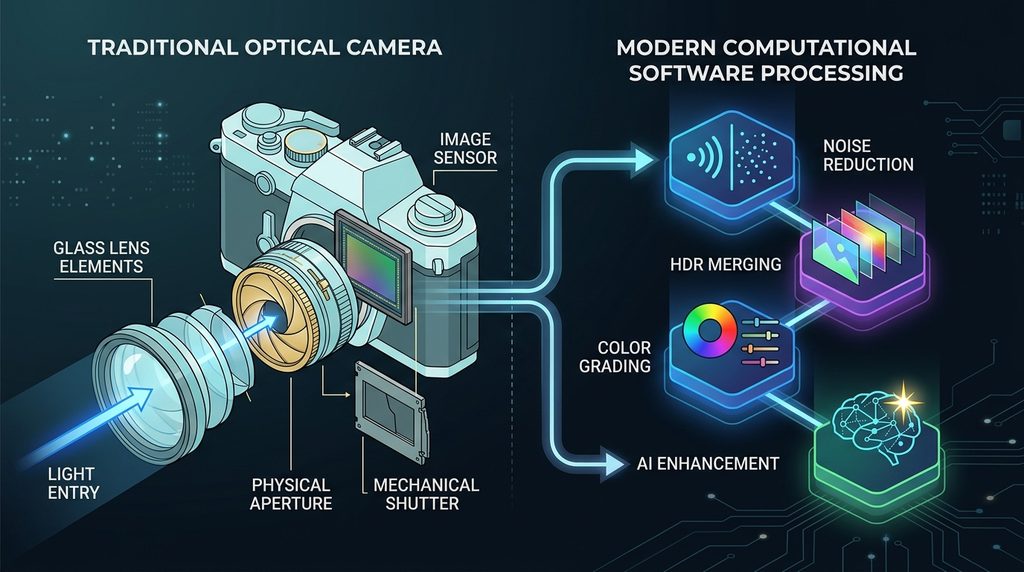
In a traditional camera, light passes through a glass lens, hits a sensor, and saves directly as an image file with minimal digital intervention. In contrast, smartphone camera software treats the light coming through the lens as raw raw data—an initial building block rather than the final picture.

Key Takeaway: Traditional photography relies on hardware optics (gathering physical light through glass). Computational photography relies on software computation (calculating, combining, and enhancing image data digitally).

Instead of taking a single picture when you tap the shutter button, a smartphone running modern computational photography algorithms captures a rapid burst of multiple images, analyzes every pixel in real-time, and merges the best parts of each frame into a single exposure.

How Computational Photography Works Inside a Smartphone

The journey from pressing “shoot” to viewing a finished picture takes less than a second, but it involves millions of mathematical calculations across specialized processing hardware.

[ Light Input ] ➔ [ Image Sensor ] ➔ [ Burst Capture Buffer ] ➔ [ ISP & NPU Alignment ] ➔ [ Final Composite Image ]

Step 1: The Sensor Capture Phase

When you open your camera app, your smartphone sensor is already constantly capturing frames into a temporary memory buffer. By the time your finger taps the shutter button, the camera has already recorded several frames before, during, and after the click.

Step 2: Multi-Frame Burst Processing

Instead of relying on one exposure, smartphone image processing uses multi-frame fusion.The camera records a sequence of shots taken at varying exposure levels—some dark to capture highlight details, some bright to extract shadow detail, and some in-between for accurate color.

Step 3: ISP and NPU Hardware Pipeline

The raw frame data routes into two crucial silicon chips inside your phone’s processor:

  • Image Signal Processor (ISP): Handles low-level raw image tasks like color correction, demosaicing (converting raw sensor data into red, green, and blue pixels), white balance adjustments, and noise reduction.
  • Neural Processing Unit (NPU): Dedicated silicon designed for AI photography tasks. It uses deep learning algorithms to detect subjects, segment backgrounds, reconstruct missing details, and optimize local exposure.

The system aligns every frame to fix micro-hand-shakes, discards blurry pixels, and stitches the best visual elements into one balanced image file.

The Role of AI and Machine Learning in Smartphone Cameras

Artificial intelligence is no longer an optional camera extra; AI photography forms the core backbone of smartphone camera technology.Modern camera apps use trained machine learning models to analyze scene geometry before you even press the shutter.

Raw Sensor Input ➔ Machine Learning Scene Model ➔ Object Segmentation ➔ Targeted Exposure / Color Polish

Semantic Segmentation and Scene Recognition

Older camera hardware applied edits uniformly across an entire image. Modern AI camera software uses semantic segmentation—breaking down an image into individual object categories like sky, skin, fabric, foliage, or architecture.

Image LayerAI Semantic Action
Human SubjectPreserves natural skin tone, brightens eyes, reduces shadow noise.
Sky / CloudsLowers highlights, enhances blue tone gradients, sharpens cloud edge detail.
Foliage / PlantsSharpens leaf edges without adding harsh digital artifacts.
BackgroundAdjusts global contrast while isolating subject lighting.

Generative Detail and AI Zoom

When zooming past a phone’s physical focal length, standard digital zoom stretches existing pixels, making photos look blurry and pixelated. Computational AI camera zoom uses neural networks trained on millions of high-resolution images to predict and reconstruct fine details—like fabric weaves, tree bark, or distant signs—turning digital crop zoom into clear images.

Key Features Powered by Computational Photography

Every modern flagship feature rely on software multi-frame merging.

Dynamic Range Mastery: HDR Photography

Traditional single-shot camera captures struggle when a scene features both bright sunlight and dark shadow pockets. HDR photography (High Dynamic Range) solves this issue by shooting rapid exposure variations:

  1. Underexposed framescapture highlights (e.g., bright sky, direct sun flare) without blowout.
  2. Overexposed framespull clear shadow detail out of dark regions.
  3. Mid-exposure frames maintain natural mid-tone color reproduction.

Computational software merges these frames pixel-by-pixel, delivering photos with evenly lit details from edge to edge.

Defying the Dark: Night Mode

Physical camera sensors require large surface areas or long exposures to gather ambient light at night. Night mode brings that functionality to tiny mobile camera sensors through computational alignment:

  • The phone captures 10 to 30 low-exposure frames over 1–5 seconds.
  • Algorithms calculate hand tremor movement between frames and realign the stack.
  • Random low-light grain and digital noise are mathematically isolated and purged.
  • Dark frames merge to accumulate ambient light without blowing out highlights or adding motion blur.

Digital Depth: Portrait Mode and Bokeh

DSLR and mirrorless lenses produce smooth background blur (bokeh) using wide optical apertures. Smartphone camera lenses are too tiny to create shallow depth-of-field naturally.

Portrait mode mimics this optical effect mathematically:

  • Dual-lens systems or stereo-vision software generate a precise 3D depth map measuring distances between objects and the lens.
  • AI algorithms segment foreground subjects (including tricky stray hair strands) away from background objects.
  • A realistic Gaussian or optical blur mask applies strictly to background depth layers, recreating true optical bokeh.

Computational Cleanliness: Noise Reduction and Sharpening

Tiny smartphone image sensors generate high digital noise in low light. Rather than smoothing photos into blurry shapes, smartphone image processing cross-references successive video frames.Static pixels retain sharpness, while random grain patterns across frames are identified and scrubbed away automatically.

Traditional Photography vs. Computational Photography

While both approaches capture visual memories, their underlying philosophies differ entirely:

Feature / TraitTraditional PhotographyComputational Photography
Primary DriverPhysical optics, glass elements, large sensor sizeCode algorithms, multi-frame bursts, processing power
Capture StyleSingle instantaneous physical shutter exposureMulti-frame dynamic exposure fusion
Form FactorBulky camera bodies and interchangeable lensesUltra-slim pocket devices
Post-ProcessingManual editing required in RAW processing appsInstant automated processing in milliseconds
Low-Light CaptureRequires physical tripods or high ISO sensitivity settingsMulti-frame handheld stabilization algorithms
Depth BlurPure physical lens optics and aperture geometryAI-generated spatial depth mapping and blur masks

Why Computational Photography Matters for Smartphones

Physics imposes strict size boundaries on hardware innovation. A smartphone cannot fit a 50mm f/1.2 glass lens or a full-frame sensor inside a body under 8mm thick without creating an unusable camera bump.

Hardware Limits (Tiny Lenses & Small Sensors)
                     +
Computational Software (Burst Fusion + AI Neural Engines)
                     =
DSLR-Class Dynamic Range & Clarity in Your Pocket

Software breaks through hardware constraints.By swapping heavy glass for raw computational horsepower, smartphone photography technology delivers image quality that challenges dedicated professional gear in everyday shooting environments.

Daily Examples: Computational Photography in Action

You use computational photography algorithms constantly without realizing it:

  • Group Photos Where Everyone Is Smiling: Camera software picks open eyes and smiles across sequential burst shots, merging them into one optimal group frame.
  • Sunset Horizon Shots:Shooting directly toward bright light captures both golden sky gradients and shadow foreground details simultaneously.
  • Concert Videos and Photos:Bright stage spotlights don’t wash out performer faces, while dark crowds remain visible and detailed.
  • Action Zoom Shots:Watching sports from stadium seats and zooming in 10x yields sharp, readable jersey text via generative detail reconstruction.

Advantages and Limitations of Computational Photography

Advantages

  • Pro Quality without Bulk: Capture high-grade images without carrying heavy lenses or camera gear.
  • Zero-Effort Perfection: Instant lighting balance, auto-focus, and colors mean anyone can shoot clear photos right away.
  • Low-Light Magic:Handheld low-light capture outperforms single exposure settings on traditional camera sensors.
  • Continuous Updates:Your smartphone camera system improves over time via software over-the-air updates.

Limitations

  • Over-Processed Aesthetics:High contrast, overly sharpened edges, or plastic-looking skin can make photos feel artificial.
  • Edge Artifacts:Portrait mode depth maps can miscalculate fine object borders like thin glass stems, dog fur, or loose hair strands.
  • Thermal and Battery Strain:Multi-frame AI processing places high power demands on mobile processors during long photo shoots.
  • Motion Artifacts (“Ghosting”):Fast-moving subjects across multi-frame HDR captures can leave faint trailing outlines if alignment algorithms struggle.

The Future of Computational Photography in Smartphones

As mobile chips feature more powerful dedicated NPUs, computational photography in smartphones is moving into real-time computational video processing and interactive generative editing.

Multi-Frame Still Processing ➔ Real-time Computational Video ➔ Generative AI & Interactive Spatial Scene Edits
  1. Real-Time 4K Computational Video:Extending complex multi-frame HDR and Night Mode algorithms across 60 video frames per second.
  2. Generative Relighting and Angle Adjustment:AI tools that let users move lighting sources or slightly adjust camera angles after capturing a shot.
  3. Generative Element Removal and Fill:Cleanly removing background distractions and reconstructing underlying textures on-device instantly.
  4. Authenticity Certification:Standardized cryptographic watermarking to help distinguish unaltered computational real photos from heavily modified generative AI imagery.

Conclusion: Software is the New Lens

The leap in mobile photography quality over the last decade wasn’t driven by bigger optical lenses; it was forged through code.Computational photography in smartphones bridges the gap between hardware physics and user expectations.

By using machine learning, multi-frame exposure processing, and neural network depth mapping, smartphones turn tiny optical components into high-grade image engines.As processors become faster and algorithms smarter, software will continue pushing the boundaries of what mobile devices can capture.

Frequently Asked Questions (FAQ)

What is computational photography in smartphones?

Computational photography in smartphones refers to software algorithms, machine learning, and hardware processing that enhance, adjust, and merge raw photo data to produce higher-quality photos than small camera optics could capture on their own.

Does computational photography replace traditional camera lenses?

It doesn’t replace physical glass entirely, but it offsets hardware physical limits.Small camera lenses still gather physical light, but computational algorithms enhance color, lighting, detail, and focus digitally.

How does Night Mode work without a tripod?

Night mode captures multiple short exposures over a few seconds.Algorithms realign these frames to correct hand shaking, purge digital noise, and merge light data into a bright, clear photo.

Why do smartphone photos sometimes look artificial or over-processed?

Over-processing happens when algorithms apply aggressive edge sharpening, high local contrast, or strong noise reduction.Tuning these software settings balances natural tone against crisp clarity.

What is the difference between an ISP and an NPU in mobile photography?

The Image Signal Processor (ISP) handles basic hardware tasks like color conversion, white balance, and noise cleanup.The Neural Processing Unit (NPU) powers AI tasks like object recognition, depth estimation, portrait blur, and semantic segmentation.

Can traditional DSLR or mirrorless cameras use computational photography?

Some modern mirrorless cameras feature basic computational modes like focus stacking or pixel-shift resolution. However, smartphones lead in this tech because their mobile processors house far more powerful NPUs designed for heavy software execution.

Posted on Leave a comment

Moving Beyond rigid IVRs: A Deep Dive into RingCentral’s AI Receptionist

In business communications, few sounds are as costly as a ringing phone that goes unanswered—or worse, a caller hanging up out of frustration while stuck in a complex phone menu (“Press 1 for Sales, Press 2 for Billing…”).

Traditional phone systems, standard Interactive Voice Response (IVR) menus, and call queues have long served as the front door for business inquiries. However, they rely on rigid rules and manual button presses that often alienate modern callers. RingCentral’s AI Receptionist represents a fundamental shift away from simple call routing toward intelligent, multi-channel customer engagement.

Here is an overview and review of RingCentral’s AI Receptionist product, exploring how it elevates phone communication, its core capabilities, pricing structure, and practical use cases.

What Sets RingCentral AI Receptionist Apart?

Traditional auto-attendants act like traffic cops: they direct traffic based on pre-programmed inputs. RingCentral AI Receptionist, by contrast, operates like a knowledgeable front-desk assistant that can engage in natural, human-like, multilingual conversations.

Rather than simply parking callers in a queue or transferring them to a busy voicemail, the AI Receptionist can fulfill requests directly during the call.

┌─────────────────────────────────────────────────────────┐
│              RingCentral AI Receptionist                │
├──────────────────────────┬──────────────────────────────┤
│  Natural Voice / AI      │  Answers FAQs & Inquiries    │
│  Contextual Call Routing │  Schedules Appointments      │
│  CRM Integration         │  Captures & Logs Leads       │
└──────────────────────────┴──────────────────────────────┘

Key Features & Capabilities

  1. Natural Interaction (No Rigid IVR Menus): Callers speak naturally instead of listening through a list of numbered options. The AI understands intent, keywords, and context, providing instant responses in multiple languages.
  2. Instant Setup & Knowledge Ingestion: Training the AI does not require extensive IT support. Businesses can quickly train the receptionist by feeding it content directly from their website, FAQ pages, or custom reference documents.
  3. Appointment Scheduling & CRM Sync: The AI connects directly to calendar tools to book, reschedule, or manage appointments in real time. It also integrates natively with platforms like Salesforce, HubSpot, and Zoho to capture intake details and log lead information automatically.
  4. Context-Aware Transfers: When a call does need human escalation, the AI transfers the customer along with full conversational context, ensuring staff members don’t have to ask callers to repeat themselves.
  5. 24/7 Availability & Multi-Call Handling: It handles high volume continuously—including after-hours, weekends, and peak overflow times—without callers encountering a busy signal or dying in a queue.
  6. Built for Regulated Industries: It supports security standards required for industries like healthcare (HIPAA support), legal, real estate, and financial services, utilizing encryption, audit logging, and strict access controls.

Pricing & Deployment Models

RingCentral offers the AI Receptionist as both an upgrade to existing setups and a flexible entry point for businesses using non-RingCentral phone infrastructure.

Plan TypeMonthly Base PriceIncluded UsageOverage RateBest For
RingEX Add-On$39 / month100 minutes included$0.50 / minExisting RingCentral users extending their unified communications system.
Standalone Plan$49 / month100 minutes included$0.50 / minBusinesses using third-party/legacy phone systems wanting smart call handling.

Note: Both options include a 14-day free trial to test workflows and call routing setup.

Real-World Impact Across Industries

Because the AI Receptionist extends beyond simple transfers, its utility varies dynamically across sectors:

  • Healthcare: Handles preliminary patient intake questions, answers common operational FAQs, and dispatches appointment follow-up texts while maintaining privacy standards.
  • Legal Services: Screens prospective clients by asking custom qualification questions, logging details into CRM tools, and transferring high-value cases to the appropriate attorney.
  • Real Estate: Manages inbound buyer calls on property listings, captures lead contact information, and schedules property showings on agent calendars automatically.

Final Verdict

RingCentral’s AI Receptionist bridges the gap between traditional telecom routing and automated customer support. By equipping the front line of your phone system with natural language comprehension, CRM syncing, and automated scheduling, it transforms missed calls from lost revenue into actionable business leads.

For small businesses needing round-the-clock coverage, or larger organizations looking to reduce call queue abandonment, it offers a pragmatic, high-value alternative to standard phone trees.

Posted on Leave a comment

Coffee Is Life: Cozy Rainy Days and the Unapologetic Power of Batangas Kapeng Barako

Category:Coffee Culture & Lifestyle

Reading Time:~4 minutes

Introduction: Coffee as a Way of Life

There is a universal consensus among coffee lovers: coffee isn’t merely a drink; it is a ritual, a comfort, and for many, a way of life. While a morning cup is essential for kicking off the daily grind, coffee elevates itself to something truly profound during the rainy and cold seasons. When gray skies settle in and a chilly drizzle taps against the windowpane, holding a warm, aromatic mug becomes an act of pure solace.

The Cozy Chemistry of Rainy Day Coffee

Why does coffee taste so much better when it’s cold or rainy outside? Science and psychology meet in a fascinating way here. Cold weather naturally prompts our bodies to seek warmth and comfort. Beyond physical warmth, the complex aroma of brewing coffee triggers the release of neurotransmitters like dopamine and serotonin, instantly lifting our mood on dreary days.

Rainy days slow down the world’s tempo. They grant us permission to pause, gaze out the window, and savor a moment of mindfulness. Whether you are wrapped in a knit blanket reading a favorite book, listening to the rhythmic pitter-patter on the roof, or tackling work from a cozy desk corner, coffee serves as the perfect companion—invigorating the mind while soothing the spirit.

“A cold day reminds us of the power of small warmth. In a single cup of brewing coffee, we find both the energy to move forward and the stillness to stay present.”

Spotlight on the Philippines: The Heritage of Batangas Kapeng Barako

While the global coffee map often highlights Arabica and Robusta, the Philippines holds a distinctive gem in coffee heritage: Kapeng Barako. Hailing predominantly from the rich volcanic soils of Batangas, Barako belongs to the Coffea liberica species—a rare type accounting for less than 2% of the world’s commercial coffee production.

The word Barako translates to a symbol of strength, masculinity, and wild energy—often associated with a strong stud or wild boar in Tagalog. And true to its name, Kapeng Barako is bold, unapologetic, and fiercely aromatic. Its large, irregularly shaped beans yield a brew characterized by a heavy body, intense woodsy and floral notes, and a deeply satisfying, smoky kick.

The Purest Experience: Drinking Barako Without Sugar

In popular café culture, coffee is frequently diluted with flavored syrups, heavy creams, and sweet toppings. While those treats have their place, tasting Kapeng Barako in its purest form—black and completely sugar-free—is a revelation.

When you strip away the sweetness, you allow the true character of the Liberica bean to shine. Drinking Barako black is not about enduring harsh bitterness; it is about discovering its subtle complexity:

  • Distinctive Floral & Fruity Aromas: Unsweetened Barako possesses a unique aromatic bouquet, often featuring hints of jackfruit (langka), dark chocolate, and anise.
  • Natural Earthy Sweetness: Without added sugar, your palate adapts to perceive the bean’s deep, natural maltiness and low acidity.
  • Invigorating Warmth: The robust flavor profile creates a lingering, comforting warmth in the chest—making it exceptionally fitting for a cold afternoon.

How to Brew Traditional Batangas Kapeng Barako at Home

To experience the authentic flavor of Batangas, skip the complicated machines and embrace the traditional decoction method:

  1. Boil the Water: Bring 2 cups of clean water to a rolling boil in a small pot or kettle.
  2. Add the Coffee: Add 2 to 3 tablespoons of coarsely ground Kapeng Barako. Turn down the heat and simmer gently for 4 to 5 minutes.
  3. Let It Settle: Remove from heat and let it steep for 2 minutes, allowing the grounds to settle naturally at the bottom.
  4. Pour & Serve: Strain into your favorite mug. Sip it black and piping hot, allowing the bold aroma to fill the room before taking your first taste.

Conclusion: Embrace the Warmth Today

The next time dark clouds gather and the temperature drops, don’t just reach for any ordinary drink. Brew a pot of authentic Batangas Kapeng Barako, skip the sugar, and let the rich, unfiltered flavors remind you why coffee isn’t just a beverage—it truly is life.

Posted on Leave a comment

AI-Powered Business Communications: How RingCentral Is Redefining the Way Companies Connect

Business communication is no longer just about making phone calls or joining video meetings. Customers expect fast answers, employees need simpler ways to collaborate, and organizations are looking for technology that can handle more work without adding unnecessary complexity.

Artificial intelligence is accelerating that transformation.

Today, AI can help businesses answer incoming calls, capture information, summarize conversations, assist employees, analyze customer interactions, and automate routine tasks. The result is a new approach to business communication—one where technology does more than connect people; it actively helps organizations move conversations toward outcomes.

RingCentral is bringing these capabilities together through its AI-powered communications portfolio, which includes business communications, AI agents, contact center solutions, meetings, and conversation intelligence. RingCentral says its platform is used by more than 600,000 businesses worldwide.

What Is AI-Powered Business Communication?

AI-powered business communication combines traditional communication tools—such as business phone systems, messaging, meetings, and contact centers—with artificial intelligence.

Instead of requiring employees to manage every step manually, AI can assist with tasks such as:

  • Answering routine customer calls
  • Understanding what callers need
  • Routing conversations to the appropriate person or team
  • Scheduling appointments
  • Capturing lead information
  • Creating call notes and meeting summaries
  • Translating messages and conversations
  • Analyzing customer sentiment and conversation patterns
  • Providing insights for sales and customer-service teams

This does not necessarily mean replacing human employees. A more practical use of AI is to remove repetitive work so people can spend more time on decisions, relationships, and complex customer needs.

Why Businesses Are Moving Beyond Traditional Phone Systems

Traditional business phone systems can handle essential functions such as call routing, voicemail, extensions, and automated menus. But modern customer expectations have raised the bar.

A customer who calls a business may want an answer immediately, schedule an appointment, receive information by text, or speak with a specialist. If the business relies entirely on manual processes, even a simple request can consume valuable employee time.

AI introduces another option.

For example, an intelligent system can understand a caller’s request, answer a common question, collect relevant information, and transfer the conversation when human assistance is necessary.

The objective is straightforward: make every customer interaction easier to handle and every employee interaction more productive.

RingCentral RingEX: Connecting Everyday Business Communications

RingCentral’s RingEX brings core communication functions into a unified platform. According to RingCentral, RingEX combines business calling, messaging, SMS, video meetings, and fax, while supporting integrations with more than 500 applications.

That unified approach can reduce the need for employees to move between disconnected communication tools.

RingEX also incorporates AI capabilities designed to support everyday work. These include real-time note-taking, meeting summaries, message composition, transcription, and translation features.

For employees, the value is less about having another AI tool and more about having AI available where communication is already happening.

Less time documenting conversations

Meetings and calls often generate important information—decisions, responsibilities, deadlines, and follow-up tasks.

AI-powered notes and summaries can help capture those details without requiring employees to manually document every conversation.

Easier collaboration

When calling, messaging, meetings, and other communication functions are accessible through one platform, teams can move between communication methods without losing the broader context.

Better support for distributed teams

Cloud-based communications allow employees to stay connected across devices and locations, helping organizations support hybrid, remote, and geographically distributed workforces.

RingCentral AI Receptionist: Turning Missed Calls Into Opportunities

One of the clearest examples of AI applied to business communication is RingCentral AI Receptionist.

RingCentral describes AI Receptionist as a 24/7 intelligent front desk that can answer calls, respond to routine questions, schedule appointments, capture leads, send text follow-ups, and route callers to the appropriate team.

This can be particularly valuable for businesses where an unanswered call could mean a lost customer.

Instead of forcing callers through rigid menu systems, AI Receptionist is designed around natural-language interactions. Businesses can provide information from sources such as their website, FAQs, and uploaded documents so the AI can use that information when handling common inquiries.

What can an AI receptionist handle?

Depending on configuration and integrations, RingCentral says AI Receptionist can:

  • Answer calls around the clock
  • Respond to frequently asked questions
  • Collect lead and intake information
  • Schedule and reschedule appointments
  • Send SMS follow-ups
  • Route calls based on caller intent and other information
  • Provide a summary when transferring a caller to a human employee
  • Connect with business systems such as CRM, scheduling, and other applications
  • Support multilingual interactions

These capabilities can help businesses maintain a responsive front desk without requiring employees to manually answer every routine inquiry.

RingCX: Bringing AI Into the Contact Center

For organizations managing larger volumes of customer interactions, the challenge goes beyond answering calls.

Contact center leaders need visibility into customer conversations, agent performance, service quality, and operational efficiency.

RingCentral’s RingCX is positioned as an AI-first contact center platform supporting voice and more than 20 digital channels. Its capabilities include AI-assisted agent and supervisor workflows, conversation analytics, workforce engagement, reporting, and customer interaction management.

RingCX also integrates with RingEX, allowing organizations to connect contact center and broader business communications workflows within the RingCentral environment.

Helping agents focus on customers

Customer-service employees frequently have to listen, type notes, search for information, follow procedures, and maintain the conversation simultaneously.

AI assistance can reduce some of that administrative burden.

RingCentral highlights capabilities such as agent assistance, supervisor assistance, AI-powered quality management, and conversation analytics within RingCX.

The potential benefit is simple: give agents more support during and after interactions while giving managers better visibility into what is happening across the contact center.

Conversation Intelligence: Turning Calls Into Insights

Customer conversations contain valuable information, but reviewing every interaction manually is difficult at scale.

AI-powered conversation analysis can help organizations identify patterns across large numbers of calls.

RingCentral’s AI Conversation Expert is designed to record and summarize sales conversations, help keep CRM information current, and provide insights and coaching opportunities.

For sales organizations, this can provide another way to understand:

  • Common customer objections
  • Topics that repeatedly arise during sales calls
  • Conversation quality
  • Coaching opportunities
  • Customer needs and interests
  • Potential areas for improvement

Rather than treating calls as isolated events, businesses can use conversation data to identify broader trends.

The Real Advantage: Automating the Entire Conversation Journey

The most interesting development in business communications is not any individual AI feature.

It is what happens when multiple AI capabilities work together.

Consider a potential customer journey:

Step 1: The customer calls.
An AI Receptionist answers immediately, even outside normal business hours.

Step 2: The customer’s request is understood.
Instead of navigating a complicated phone tree, the caller can explain what they need.

Step 3: A simple request is handled automatically.
The AI can answer a common question, collect information, schedule an appointment, or provide a requested follow-up by text.

Step 4: A complex request reaches a human.
If the issue requires an employee, the conversation can be routed to the appropriate person with relevant context.

Step 5: The interaction becomes data.
Conversation intelligence and analytics can help the organization understand what happened and identify potential improvements.

This is the broader promise of AI-powered communications: automate what can be automated, assist people where human involvement matters, and analyze interactions to improve future performance.

AI Should Enhance Human Communication, Not Complicate It

Technology adoption can fail when employees are given more tools but not better workflows.

That is why integration matters.

RingCentral’s platform is designed to bring communication and AI capabilities into a connected environment, while also supporting integrations with business applications. RingEX, for example, advertises integrations with more than 500 applications, while RingCX provides additional integration and API capabilities for contact center environments.

For businesses evaluating AI communications technology, the key question should therefore be more than, “Does it have AI?”

A better question is:

Can the AI fit naturally into the way our people and customers already communicate?

What Businesses Should Consider Before Adopting AI Communications

Before implementing an AI-powered communications platform, organizations should evaluate several areas.

1. Customer experience

Does the technology make it easier for customers to get help, or does it create another obstacle?

2. Human handoffs

Can customers reach a real person when they need one? And does the employee receive enough context to avoid making the customer repeat everything?

3. Integration

Can the communications platform connect with CRM, scheduling, collaboration, and other business systems?

4. Scalability

Can the solution support the organization as call volumes, locations, employees, and customer interactions increase?

5. Analytics

Can the business learn from its conversations rather than simply store them?

6. Security and responsible AI

Businesses should also understand how customer and employee data is handled. RingCentral states that it does not use customer data to train its AI models and highlights privacy, security, transparency, and compliance as part of its AI approach. Organizations should still review the applicable product documentation, configurations, and contractual terms for their specific use case.

The Future of Business Communications Is AI-Assisted

Business communication is evolving from a system that simply connects people into an intelligent layer that can help manage the interaction itself.

AI can answer routine questions. It can assist employees. It can summarize meetings. It can analyze conversations. It can help contact centers understand customer behavior. And increasingly, AI agents can perform specific communication-driven tasks from beginning to end.

RingCentral is building toward this model with its portfolio of RingEX, RingCX, AI Receptionist, AI Conversation Expert, and other AI capabilities.

For organizations considering their next communications investment, the opportunity is not simply to replace an outdated phone system.

It is to rethink what business communication can accomplish.

Ready to Explore AI-Powered Business Communications?

Whether your priority is reducing missed calls, improving employee productivity, strengthening customer service, modernizing your contact center, or gaining more insight from conversations, AI can become a practical part of your communications strategy.

Explore RingCentral’s AI-powered communications solutions to see how business calling, messaging, meetings, contact center capabilities, and AI can work together.

Visit RingCentral.com to explore the platform, compare solutions, and discover how AI-powered communications can help your organization create better customer and employee experiences.

Sources and editorial note

This article is original editorial content written specifically for publication. It does not reproduce RingCentral’s website copy. Product names, capabilities, and current platform claims were checked against RingCentral’s official website and supporting product pages as of August 2026.

Posted on Leave a comment

Google Drive: Streamlining Content Delivery

This blog post from redimedia.site champions Google Drive as a superior solution for content delivery. It highlights Google Drive’s versatility in handling diverse file types, ease of access from any device, and robust collaboration features. The post also emphasizes its version control, ample storage, and strong security measures. Ultimately, the article positions Google Drive as an efficient and secure platform for streamlining content sharing in various collaborative projects.

n this episode, we dive into why Google Drive stands out as a top-tier solution for content delivery, inspired by a post from Redimedia.site. We discuss its versatility in managing diverse file types, seamless accessibility across devices, and powerful collaboration tools. From version control to ample storage and strong security measures, we unpack how Google Drive simplifies and secures content sharing for any project. Whether you’re working solo or with a team, this episode highlights why Google Drive is the go-to platform for efficient and streamlined collaboration.

YouTube: https://youtu.be/ncf_RUorBFM

Rumble: https://rumble.com/v69j48a-google-drive-streamlining-content-delivery.html

Dailymotion: https://dai.ly/k5iZQ4jkzhazcWCeGKC

Posted on Leave a comment

Top Web Hosting by SiteSculpt

This blog post from redimedia.site, originally authored by SiteSculpt.site, compares different web hosting options. It details the advantages and disadvantages of shared, virtual private server (VPS), and dedicated hosting, emphasizing the importance of considering website needs (traffic, software requirements) when choosing a plan. The post guides readers toward selecting the most suitable hosting solution based on their website’s specific demands and offers assistance via live chat or phone. Ultimately, it aims to help users make an informed decision about web hosting.

In this episode, we break down a blog post from redimedia.site, authored by SiteSculpt.site, that compares the pros and cons of shared, VPS, and dedicated web hosting options. We discuss how to match hosting plans with your website’s needs—whether it’s traffic volume or software requirements—and provide tips for making the best choice. Plus, learn how to access expert guidance through live chat or phone support. Tune in to gain valuable insights and make informed decisions about your web hosting journey!

Website: www.sitesculpt.site

Youtube: https://youtu.be/vxsxIorInFE

Rumble: https://rumble.com/v6921l7-top-web-hosting.html

Dailymotion: https://dai.ly/k6HFtlz8FcapU3CdNuc

Posted on Leave a comment

Book 1: Money Masters: 50 Fun Stories Teaching Financial Literacy, Investing, Entrepreneurship, and Smart Money Habits for Kids

The Young Money Guide: 100 Stories on Financial Literacy, Investing, and Smart Spending for Kids

In this podcast, we dive into The Young Money Guide: 100 Stories on Financial Literacy, Investing, and Smart Spending for Kids.

Book 1: Money Masters: 50 Fun Stories Teaching Financial Literacy, Investing, Entrepreneurship, and Smart Money Habits for Kids. Each episode features fun, fictional stories designed to teach children essential financial concepts such as saving, budgeting, avoiding debt, and using digital currency. These stories are set in the context of video games and engaging scenarios, making finance exciting and easy for young listeners. Our goal is to help kids develop healthy financial habits early, while enjoying the journey of learning about money management.

Get this Product: https://redimedia.site/product/book-1-money-masters-50-fun-stories-teaching-financial-literacy-investing-entrepreneurship-and-smart-money-habits-for-kids/

YouTube:
https://www.youtube.com/live/BdVyZXSRpm4

Rumble:
https://rumble.com/v652kvm-the-young-money-guide-book-1money-masters.html

Dailymotion:
https://dai.ly/x9bmbea

Posted on Leave a comment

Icon Generator Review: Is This Free Browser-Based Icon Generator Worth Using?

Link: https://redimedia.site/webapps/icon_gen/icon_gen.html

Every website, mobile application, and Progressive Web App (PWA) needs properly sized icons. Whether it’s a favicon displayed in a browser tab, an Android home screen icon, or an Apple touch icon, creating dozens of image sizes manually can quickly become a repetitive and time-consuming task.

Fortunately, browser-based utilities have made this process much easier. One such tool is the redimedia Icon Generator, a lightweight web application designed to generate multiple icon sizes from a single image.

Unlike many online image processing services that require uploads to a remote server, RediMedia’s approach focuses on speed, simplicity, and local browser processing. This makes it an attractive option for developers, designers, students, and hobbyists who want to create application icons without installing additional software.

In this review, we’ll explore its features, usability, strengths, limitations, and whether it’s worth adding to your web development toolkit.


What Is the redimedia Icon Generator?

The redimedia Icon Generator is a browser-based utility that converts a single source image into multiple icon sizes suitable for modern websites and applications.

Instead of manually resizing an image several times in Photoshop, GIMP, or another graphics editor, the tool automates the process. Within a few clicks, users can generate a complete collection of icons for different platforms and download the finished assets.

Its primary goal is simple:

Save developers time while producing consistent, high-quality icons.

This makes it especially useful for:

  • Website developers
  • Progressive Web App (PWA) creators
  • Front-end developers
  • Mobile app developers
  • UI/UX designers
  • Students learning web development
  • Freelance web designers

First Impressions

One of the strongest aspects of the redimedia Icon Generator is its minimalist interface.

Rather than overwhelming users with advanced editing tools, filters, or dozens of export settings, it focuses on the essential workflow.

The process is straightforward:

  1. Upload an image.
  2. Generate the required icon sizes.
  3. Download the finished assets.

There is very little learning curve, making the tool approachable even for beginners who have never created favicons before.

For experienced developers, the simplicity is equally appealing because it eliminates unnecessary steps.


Browser-Based Processing: A Major Advantage

Perhaps the most notable feature of the redimedia Icon Generator is that image processing takes place directly in your web browser.

This provides several important benefits.

Improved Privacy

Since the image is processed locally, users don’t have to worry about uploading files to external servers. For organizations handling proprietary logos or branding assets, local processing adds an extra layer of confidence.

Faster Performance

Without server uploads, icon generation feels almost instantaneous.

There are no waiting queues, upload delays, or processing times that often accompany cloud-based image tools.

Reduced Internet Dependency

Once the application loads, much of the processing happens on the client side. This contributes to a responsive experience, especially when working with larger images.


Features That Make the Tool Useful

Although lightweight, the Icon Generator includes several features that make it practical for everyday development work.

Multiple Icon Sizes

Modern web applications require numerous icon dimensions.

Instead of resizing manually, the tool generates multiple versions suitable for different devices and operating systems.

This saves significant development time.


Consistent Image Quality

Manually resizing icons often introduces inconsistencies.

Automated generation ensures every icon is created using the same source image and scaling process, resulting in a more consistent visual identity across platforms.


Beginner-Friendly Design

The interface avoids unnecessary complexity.

There are no advanced image editing menus to navigate before generating icons.

This makes it an excellent utility for beginners, students, and users who simply need icon files without learning professional graphics software.


Lightweight Experience

Unlike some feature-heavy design platforms, the application remains lightweight and responsive.

Pages load quickly, and the overall experience feels uncluttered.


Why Developers Need an Icon Generator

Many first-time developers underestimate how many icon sizes modern websites require.

A typical website may include:

  • Browser favicon
  • Apple Touch Icon
  • Android Chrome icon
  • PWA launcher icons
  • Windows tile icons
  • Manifest icons
  • Various high-resolution versions

Creating each manually can become tedious.

An icon generator automates this repetitive work, allowing developers to focus on building their application rather than resizing graphics.


Real-World Use Cases

The redimedia Icon Generator fits naturally into many development workflows.

Launching a New Website

Before deploying a website, developers often need favicons and touch icons.

The tool makes it easy to generate these assets from a single logo.


Building a Progressive Web App

PWAs require multiple icon dimensions for installation across different devices.

Instead of preparing each size manually, the generator streamlines the process.


Mobile Application Branding

Developers creating Android or cross-platform applications frequently need icon variations.

Using one source image ensures consistent branding throughout the application.


Educational Projects

Students learning HTML, CSS, JavaScript, or web development can quickly create professional-looking icons without purchasing commercial software.


Performance

Performance is one of the application’s strongest qualities.

Because everything happens locally, generating icon sets typically feels immediate.

Even on average hardware, there is little noticeable delay between uploading an image and receiving the finished output.

This responsiveness contributes to a smooth user experience.


Strengths

After reviewing the tool, several advantages stand out.

Simple Interface

The design prioritizes usability.

Users can begin generating icons almost immediately.

Fast Processing

Local browser processing minimizes waiting time.

Privacy-Friendly

Images remain on the user’s device rather than being uploaded to external servers.

No Software Installation

Everything works directly from the browser.

There is no need to install desktop applications or browser extensions.

Time Saving

Generating multiple icon sizes manually can take several minutes—or even longer when adjustments are required.

Automation dramatically reduces this workload.


Areas for Improvement

While the Icon Generator performs its core function effectively, a few additional features could make it even more versatile.

Live Device Preview

Displaying how icons appear on browsers, smartphones, tablets, and desktop shortcuts would help users evaluate the final result before downloading.

Basic Editing Tools

Simple options such as:

  • Image cropping
  • Padding adjustments
  • Background color selection
  • Corner radius controls

would increase flexibility without making the interface overly complicated.

Dark Mode

A dark theme would improve usability for developers who spend long hours working in code editors and development environments.

Drag-and-Drop Upload

Supporting drag-and-drop image uploads would create an even smoother workflow.

Batch Processing

Allowing multiple source images to be processed simultaneously would benefit agencies and designers managing larger projects.


Who Should Use the redimedia Icon Generator?

This tool is particularly well suited for:

  • Front-end developers
  • Full-stack developers
  • Web designers
  • UI/UX designers
  • Freelancers
  • Students
  • Startup founders
  • Small businesses
  • Indie app developers

Anyone who regularly builds websites or web applications can benefit from having a fast icon generator readily available.


Final Verdict

The redimedia Icon Generator succeeds by focusing on practicality rather than feature overload.

It delivers exactly what many developers need: a quick, reliable, and privacy-conscious way to generate multiple icon sizes from a single image.

Its browser-based processing makes it both fast and convenient, while the clean interface keeps the learning curve close to zero. Beginners can generate icons within minutes, and experienced developers will appreciate how efficiently it fits into existing workflows.

Although additional customization options—such as live previews, cropping tools, or dark mode—would make the application even more compelling, these omissions do little to diminish its overall usefulness.

If your goal is to produce favicon files, PWA icons, or application icon sets quickly without installing desktop software or relying on cloud-based image editors, the redimedia Icon Generator is well worth bookmarking.

Overall Rating

CategoryRating
Ease of Use⭐⭐⭐⭐⭐
Performance⭐⭐⭐⭐⭐
Features⭐⭐⭐⭐☆
User Interface⭐⭐⭐⭐⭐
Privacy⭐⭐⭐⭐⭐
Overall4.7/5

Key Takeaways

  • Fast browser-based icon generation
  • No software installation required
  • Local image processing for enhanced privacy
  • Simple, beginner-friendly interface
  • Excellent for websites, PWAs, and mobile applications
  • Saves developers valuable time during project setup

Whether you’re launching your first website or maintaining dozens of client projects, the redimedia Icon Generator offers a streamlined solution for one of web development’s most repetitive tasks. It’s a practical utility that earns a place in any developer’s collection of everyday web tools.

Link: https://redimedia.site/webapps/icon_gen/icon_gen.html

Posted on Leave a comment

Free Online Digital Clock – Simple, Accurate, and Full Screen

Welcome to the Digital Clock by redimedia, a fast and distraction-free online clock designed for everyday use. Whether you need to keep track of time while working, studying, teaching, presenting, or relaxing, this browser-based clock provides a clear and accurate display that updates in real time.

The minimalist interface makes it easy to read the current time at a glance. With large digital numbers, a visible date, and fullscreen support, it works perfectly on desktops, laptops, tablets, smart displays, and mobile devices.

Features

  • Real-time digital clock synchronized with your device’s system time.
  • Large, easy-to-read display suitable for classrooms, offices, and home use.
  • Fullscreen mode for presentations, study sessions, or wall displays.
  • Light and dark themes for comfortable viewing in any environment.
  • Responsive design that adapts to phones, tablets, and desktop browsers.
  • No installation required—simply open the page and start using it.

Perfect For

  • Students during online classes or exams.
  • Teachers displaying the current time in classrooms.
  • Professionals managing meetings and work sessions.
  • Home offices and productivity setups.
  • Digital signage and information displays.
  • Anyone who needs a reliable online clock.

Why Use an Online Digital Clock?

Unlike traditional desktop applications, an online digital clock works instantly in your web browser. There is nothing to download or configure. Since it relies on your device’s current time, the display is fast, lightweight, and always available wherever you have a modern web browser.

Whether you’re timing presentations, monitoring schedules, or simply keeping a clock open on a second monitor, this web app provides a clean experience without unnecessary distractions.

Simple by Design

The Digital Clock focuses on what matters most: displaying the current time clearly and accurately. Its uncluttered design makes it ideal for everyday use while maintaining excellent readability across all screen sizes.

Open the page, switch to fullscreen if needed, and let the clock do the rest.

Stay on time with redimedia’s free online Digital Clock—simple, reliable, and always ready when you need it.

Link: https://redimedia.site/webapps/